Monday, 3 August 2015

Commercial Value Of Anthruim

Anthurium cut-flowers are known for their relatively long vaselife that ranges from a week to two months this is the chief factor in the commercial appeal of this flower.Florist will pay more for  a flower lasting  5 -6 weeks in an arrangement when the average vaselife of other arrangements is 6 days.  Anthurium importers prefer cultivars with a long vaselife to ensure that the cut-flowers will retain their freshness throughout the transportation, distribution and retail chain.  Commercially, a vaselife of three weeks and over is required to market anthurium cut-flowers.This flower is unique in that it is thought to have the longest vaselife of cut flowers worldwide.
The Commercial value of this flower is enhance by the size of the bloom and the wide variety of colours available . The spathe , also called the bract  or colourful part of the bloom varies from11-24 cm. depending on variety.

Researchers at the UWI have studied the vaselife of several anthurium cultivars under standard conditions. We found large variations in the vaselife of anthurium cultivars grown in the Caribbean. Several studies were carried out to determine the morphophysiological characteristics associated with vaselife.  Based on this study selection equations have been developed to predict vaselife in breeding programmes. Using these equations, the assessment of vaselife of anthurium cultivars can be done in as little as 5 days with great precision, without having to carry out vaselife experiments, which take two months.  This can greatly accelerate breeding programmes aimed at improving vaselife, and reduce cost.


It's an Exotic Flower

The term "Exotic is used to describe a flower that adds an extra touch ,call it sophistication, to the floral arrangement or garden where it is displayed . Cut Flowers, Wild Flowers, Tropical as well as Exotic Flowers are types that categorize flowers . The Anthurium whose natural habitat is an equitorial climate is also Tropical.Since this environment is condusive to their natural growth and development they are less expensive to produce in the tropical West than they are in Holland.The term "Exotic" for anthuriums originate with Temperate countries which grow them. They are so described because exotic plants do not grow naturally in these areas  into which  they were imported and altered to be commercialised. These plants can be invasive and wreck havoc on ecosystems by outcompeting native plants and disrupting food chains. In order for these exotic plants to survive in Temperate countries growers such as ANTHURA B.V of Holland grow their flowers in green houses, with controlled heating and special feeding systems,all technology driven.  There used to be a booming anthurium export industry coming out of Caribbean islands such as Trinidad , Jamaica and Guyana as well as Hawaii.However since about 2006 the industry has been threatened by root rot diseases and also by devastation of hurricanes. The thriving anthurium industry in Jamaica was wiped out by hurricane.
                                                      Spider orchid

HORTICULTURAL MANAGEMENT

When caring for anthurims the farmer's chirf concerns are shade, irrigation, feed and sanitation. Even through it is a tropical bloom it cannot thrive in full sunlight. For this reason the normal varieties pink and white are grown in shade under trees. However commercial varieties, most of which have been genetically altered must have shade cover to eleminates 35%of the sunlight. There are green houses made of saren netting under which which these senitive plants bloom. From seedling to full adulthood, it takes about one year to grow a commerical quality flower of approximately 1 foot long and 4" wide. Flowers grow in size as the plant grows older Sanitation is very important. There are diseases that are minimised by growing the flower under the shade house, as well as spraying them with chemicals to destroy root funigus such as root rot. Spraying also prevents damage by insects that bite the leaves.These bites can leave specks or holes on the flowers, rendering them unsaleable on the commerical market. To prevent diseases such as zantimonas chemical water ponds are placed at the entrance of the shade house for workers/visitors who enter to dip their boots into it . This sanitation  practice helps to prevent the carting of bacterica into the shade house. Gloves prevent hand borne dieases and all other implements, while in use cutting and grooming the plants are sanitized. Untreated pond water cannot irrigate these plants. The water may taken be from tanks or cistern with clean water supply and applied about 3 times per day in dry season by use of sprinklers. The plants are fed by adding the NPK to water before irrigration.
                                                  IRRIGRATION PROCESS      
.diagram showing ground irrigation system 

Thursday, 23 July 2015

WEAKNESSES AND THREATS

 The Anthurium plant was first known in the Caribbean as  an ornamental, cherished by home flower gardeners.Within  the last 30 years, however ,their chief appeal  is in their marketability for flower export  to Temperate countries.  Initial efforts to establish an export oriented anthurium industry in the Caribbean in the 1980s and the 1990s was based on imported hybrids from the Netherlands. The early successes in the region were followed by a general demise of the industry due to varying reasons, the most important being the high cost of imported planting material, poor adaptability of cultivars to Caribbean conditions, susceptibility of imported cultivars to bacterial blight and bacterial leaf spot diseases, lack of novelty, scale of production or the organization necessary to penetrate into new markets.  Only the more progressive farms were able to develop innovative solutions to the problems that allowed them to survive in spite of the decline.  As a result the markets have shrunken and the industry in a state of disarray and inertia. 

A high level of organization of the industry is required to penetrate into international markets. However, to date, there is no vision or a regional strategic development plan for the expansion of the industry.  Furthermore, much of the information with regards to cultivars, sources of plantlets, anthurium growing methods, disease management regimes, markets and sources of funding for industry development is either not available or not accessible to the farmers.  Lack of any initiatives in these areas would result in the threat of permanent loss of the potential North American markets to other players in the hemisphere.

Therefore it is imperative, given our strengths, to immediately develop a strategic plan towards the development of the anthurium industry.


Sunday, 19 July 2015

Hobbyist or Commercialist ;growing and caring

Though the Tropics is its natural habitat the Anthurium needs special care and attention in order for it to be healthy and producing flowers at maximum level. Whether one is a hobbyist or a commercialist would determine the care and treatment given to the Anthurium plant. The hobbyist emphasis is on personal satisfaction.This would involve smaller amounts under cultivation :just enough to fill the vase ,or make a wreath or decorate a room.It may even involve personal experiment being done to develop stronger, more beautiful or durable species.I had a friend who was a rose hobbyists. She knew how to graft roses, so she got pleasure in designing two toned roses.BY so doing the hobbyist can become a plant researcher and graduate into becoming a plant scientist. When the hobbyist purchases the original plants he can care for them under trees , in small green houses or under cover of saran netting,for shade. He could hand water and fertilise by mixing the NPK solution to manually fertilize. By personal care he will increase his garden size.Using hands on experience he'll recognise rhizomes and by removing and replanting their new shoot the gardener grows new plants .Being diligent in his hobby the hobbyist may start small and end up with a large garden, maybe even become an entrepreneur, having a farm he has become a commercialist, creating income for himself and his country. . There is relaxation that some folk experience in growing plants, maybe a particular plant as an anthurium or an orchid is more satisfying to the hobbyist . He would spend hours in stress relieving activity of tending his plants and just admiring the blooms. In order to help the commercialist  determine his minimum size farm I would have him quantify the amount of funding needed for the commercial venture. Emphasis must be placed on both the quality and quantity of blooms which must be without blemish for export to the US, our main market. A financially viable shipment must be of a minimum of about 1000 blooms per week.Taking note that a mature anthurium plant flowers once per six weeks, a minimum sized farm should be 9000 plants , bearing in mind that  not all blooms will be of export quality. I had a backyard farm  of 7000 plants,covering18000 sq feet plot ,yet I had great difficulty doing 1000 blooms per week.simply because blemish free , ist class quality is a challenge to produce beyond 60% of your harvest, but where I failed in profitability I gained in satisfaction of seeing beautiful anthuriums week after week
. In my next post I'll discuss more about the infrastructure relating to the care of these plants. > NPK: These numbers represent three different compounds: Nitrogen, Phosphorous, ans Potash (potassium) which we can also describe with the letters N-P-K. these three numbers listed on fertilizer labels correspond to the percentage of these materials found in the fertilizer.

Thursday, 16 July 2015

The agriculture economy of the region has been greatly eroded by the loss of preferential markets for sugar and banana. Anthurium has been targeted as an important crop with export potential in the region’s diversification efforts.  Smaller farms with more intensive production systems, a characteristic of farming in small island developing states, is more suited for growing ornamentals than field crops or tree crops.  Furthermore, the proximity of the Caribbean to the attractive North American market, which is serviced daily by direct flights, historic ties with various European markets, the expanding intra-regional market and growing linkages with the regional tourism industry provide enormous potential for the expansion of the industry.
Other opportunities include:

  • Opportunities for Small-Island Caribbean States to establish a competitive agro-industry. 
  • Relief to farmers displaced from banana and sugarcane by engaging in an innovative activity.
  • Opportunity for greater linkages with the tourism industry will assist in retaining the tourism revenue within the Caribbean region.
During the past 25 years innovative systems of growing anthurium in the tropics under shade houses have been developed by progressive farmers in the region.  Considerable research effort, particularly at the University of the West Indies (UWI), has been expended in accumulating elite germplasm, learning to manage diseases, screening for disease resistance, breeding for resistance, bioengineering for novel cut-flower colours, developing micropropagation systems to rapidly multiply anthurium at minimal cost etc.  Recently a number of novel varieties that combine resistance with good horticultural attributes have been developed in a collaborative effort between Kairi Cut-flowers Ltd and UWI, St. Augustine. Bioengineering these varieties for novel colours is presently underway at UWI. A semi-commercial tissue culture facility has been established at UWI, St. Augustine to supply planting material to farmers. In the marketing front, flower arrangements with anthurium by the Caribbean florists have consistently won high awards in international horticultural shows. This coupled with the fact that anthurium has the longest vaselife of any known ornamental flower augurs well for its marketing. These developments provide great promise for resuscitating the Caribbean anthurium industry.

Monday, 13 July 2015

Introduction

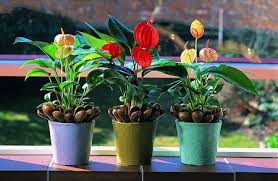
There is a common saying that the way to a man's heart is through his stomach. I wish to add that the way to a woman's heart is through flowers. I have yet to meet a woman who is not moved by them. Flowers present themselves in bridal bouquets , in flower garden and as part of home decor. Their most common use is as funeral wreaths. On a national scale the Hawaiian necklace garland of flowers called a lei is a welcome gift given to tourist arriving at the Polynesian ports. There is no social barrier to flower giving .Any one can acquire flowers for they can be found even on roadsides,but not all varieties are easily acquired. Such a one is the Anthurium Lily, a Tropical bloom that is classified as exotic. As a child I recognised the anthurium as a special plant that my grandmother grew under the mango tree.She used rotten immortel tree to mulch, and she fertilized with diluted human urine (stale pee) The flowers were of colours pink and white, with stems of average 10- 12 "long.These were cut when the plant grew to the size producing flowers of approximately 7 cm diameter. She started with 4 plants and increased her collection to about 24 plants through young shoots, in order to harvest a bouquet of flowers which adorned the dining table for up to 3 weeks.That was then. The Anthurium Lily in its indigenous form has been replaced by the Anthurium andraeanum Linden ex Andre.This is a hybrid version developed by the Dutch. The local Anthurium Lily was taken by the Dutch horticulturist and genetically engineered to produce new varieties that are commercially viable.They were reintroduced to the Trinidad market by Eugene Andre`.It is no secret that Holland, a Temperate country, controls the international Flower industry by introducing technology into the flower industry.They have perfected the conditions of temperature, feeding levels , exposure to sunlight and other features that would sustain the flower in its present form. The pictures displayed indicate the various bright colours that are now available on the commercial market